The Tale of the Phantom Time Hypothesis: A Calendar Conspiracy
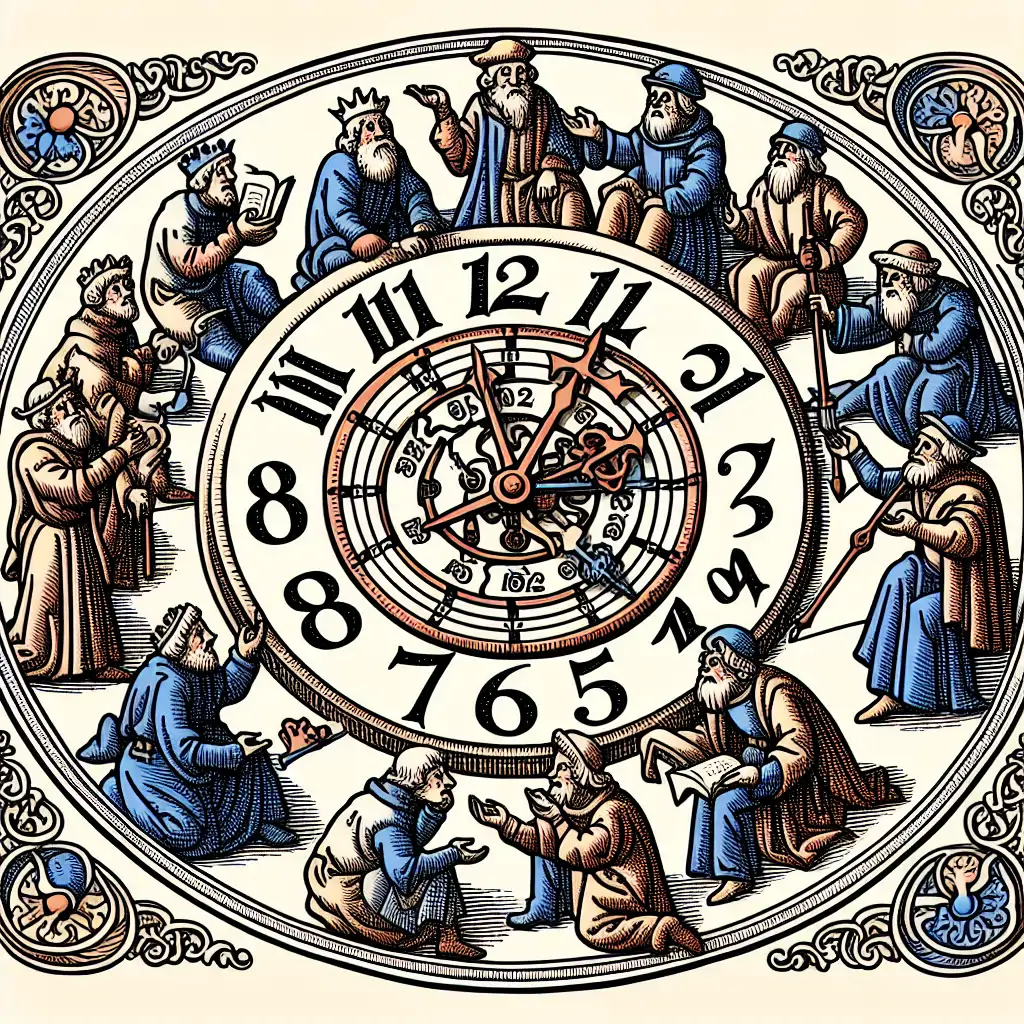
What if I told you that nearly three centuries of the Middle Ages never happened? That's the audacious claim of the Phantom Time Hypothesis – an idea that sounds like it came straight out of a Dan Brown novel. Developed by the German historian Heribert Illig in the late 20th century, this theory suggests that the years between 614 and 911 AD are nothing more than a monumental mistake, or worse, a deliberate fabrication. It’s a proposal so radical that it invites both intrigue and incredulity. According to Illig, a trio consisting of Holy Roman Emperor Otto III, Pope Sylvester II, and Byzantine Emperor Constantine VII conspired to manipulate the calendar, adding phantom years to mark the beginning of the year 1000 during their reign. Why, you ask? To bestow grandeur and legacy upon their rule, of course.
So how does such a bewildering notion take root and evolve into a full-blown theory? Phantom Time isn't just about curious conspiracies; it's a complex critique of historical chronology, one that questions the very tools historians use to unravel the past. Illig points to a lack of archaeological evidence and suspicious chronological records, suggesting these mythical years were simply invented to fill gaps, akin to ghost pages in history's great book. Skeptical? You wouldn't be alone, but before you dismiss Illig as just another outlandish thinker, there's more to unpack. In this chronicle of conspiracy, we'll dig through the layers of supposed deceit and examine the arguments that have tantalized some and infuriated others.
Does this mean that Charlemagne, the legendary ruler who shaped medieval Europe, was nothing more than a figment of the imagination? Did centuries worth of innovations, battles, and political maneuverings occur in a blink of illusionary time? Settle in for this mind-bending journey as we unravel the threads of the Phantom Time Hypothesis. It’s a tale of historical intrigue and audacity, where the past isn't just a foreign country but potentially a fabricated one.
Now that you're hooked, let's dive deeper into the specifics of the Phantom Time Hypothesis. This theory rests on the sensational claim that the entire early Medieval period, marked between 614 and 911 AD, is nothing but an elaborate fabrication. While this might seem like a medieval prank gone too far, Illig's argument has caught the interest of both curious spectators and scholarly critics who are intrigued by its audacity and questioning nature.
Illig's hypothesis begins with the Gregorian Calendar reform of 1582, which had to correct the drifting dates of the Julian Calendar by removing ten days. Illig found it perplexing that ten days needed to be adrift when calculations, according to him, implied that thirteen days should have been accounted for. Suspecting a three-century discrepancy, Illig posited that the phantom years were superfluous insertions – a monarchic ruse to capitalize on the prestige associated with the new millennium.
But how could such a significant alteration of temporal records occur? Illig suggests complicity at the highest levels of ecclesiastical and political power. Otto III, with his penchant for grandiosity, wanted to align his reign with the illustrious year 1000 AD. In cahoots with Pope Sylvester II, fresh off his own papal innovations, they allegedly toyed with time, persuading Byzantine Emperor Constantine VII to play along.
The evidence Illig cites is as colorful as the claim itself. He refers to the paucity of archaeological evidence to support significant development between 614 and 911 AD in Western Europe. Furthermore, he points to mysterious gaps in historical records, as well as anomalies in astronomical observations that seem inconsistent with established chronology. According to Illig, architects of the deception shuffled the historical deck, eliminating critical timestamps to produce an illusionary epoch.
Charlemagne, the monumental emperor credited with unifying vast European territories, becomes a central figure in this narrative. To accept Phantom Time, one must also entertain the possibility that Charlemagne is akin to King Arthur – perhaps not entirely mythical but distorted beyond recognition. Illig's skepticism extends to the Carolingian Renaissance, which he argues lacked true innovation and was a 'rebirth' of pseudo-events orchestrated to fortify an imaginary timeline.
Skeptics, however, find Illig's theory to be a fertile field of conjecture rather than an orchard of truth. Critics argue that the lack of archaeological findings is more indicative of the period's archaeological obscurity than evidence of a chronological misadventure. The so-called 'Dark Ages' were named for a reason, characterized by societal tumult, paltry infrastructure, and limited cultural documentation, necessitating careful interpretation rather than conspiracy accusations.
Historical records, rich with inconsistencies and overlaps, are a patchwork quilt that seldom aligns neatly. The Phantom Time Hypothesis seems to many historians as an exercise in extreme revisionism, one that overlooks the evolutionary nature of historical inquiry by zeroing in on a rigid idea. Chronology is a craft, requiring its practitioners to weave through conflicting evidence to stitch together a coherent narrative without resorting to imaginative leaps.
Astronomers and scientists have weighed in too, harnessing the empirical lenses of their disciplines to scrutinize Illig’s claims. Lunar eclipses, solar sightings, and celestial navigations exhibit patterns and alignments that validate, rather than question, the currently accepted chronology. The cosmos, unlike human records, is less susceptible to deception and lends its light to guide historians through time’s labyrinth.
Despite these rebuttals, Illig’s Phantom Time remains alluring, appealing to those who relish challenging convention or find delight in historical what-ifs. It captures the zeitgeist of a postmodern mindset that questions authoritative narratives and envisages alternate histories. In this view, curiosities like Phantom Time serve a cultural function, sparking dialogue and engaging the public imagination with provocations rather than proofs.
But where does this leave us, faced with a hypothesis indulging in historical illusion? For Illig, the burden of proving his thesis lies behind curtains of secrecy and deception, leading followers to embrace a worldview where grand conspiracies eclipse mundane reality. For critics, it’s a reminder of the continuous conversation that defines historical scholarship, demanding diligence in pursuit of the past's elusive truths.
The legitimacy of the Gregorian reform is still subject to inquiry as part of a broader historiographical debate. While Illig may have asked questions years ahead of others, the answers he proposes rarely withstand rigorous scrutiny or satisfy scholarly appetites for evidence-based analysis. But in raising these questions, he has unintentionally fueled a movement. As they say, we learn as much from mistakes as from triumphs.
It’s essential to understand that the Phantom Time Hypothesis isn’t just a denouncement of history, but a critique of its methods. Illig challenges historians to refine their tools of investigation to preempt comparable hypotheses lying in wait. This reflection becomes a clarion call for historians and related disciplines.
Intriguingly, Phantom Time connects with other fringe hypotheses entertained by spirited seekers of historical truths. Whether it's believing that ancient aliens visited civilizations or that Atlantis sunk beneath the waves, such narratives tap into humanity's boundless capacity for mystery and wonder, engaging our penchant for imagination beyond the confines of mainstream acceptance.
Let’s not forget the sheer entertainment factor in Illig’s elaborative storytelling. Phantom Time belongs more to the genre of speculative fiction than it does to sober academic discourse. Like a history-infused 'Twilight Zone' episode, it delights in shaping narratives that skew our understanding of the possible, teasing readers with tantalizing hints before disappearing into temporal mists.
Critique and theatrics aside, Phantom Time gives us a meeting point, a juncture where skepticism, creativity, and scholarship interact dynamically. A sandbox for historians and thinkers, it encourages diversions from traditional pathways. Whether regarded as revelation, speculation, or purely absurd entertainment, its place in history of ideas invites further questioning of what feeds the human yearning to harmonize curiosity with understanding.
As we draw our temporal tale toward a close, it’s worth considering how Illig's thesis, for all its perceived flaws, brings attention to the processes by which the past is constructed. From scribes at the Vatican manuscripts to digital historians of today, every age participates in the creation of history’s canvas. Recognizing false patterns, artifacts, or conspiracies is deemed a part of this professional calling.
Ultimately, the Phantom Time Hypothesis serves as a reminder that the past is tantalizingly out of reach but ever on the cusp of rediscovery. While the pages where these phantom years must reside may not hold material evidence, in our continued inquiry and reflection, history accompanies us as a partner rather than a static record.
The trickster spirit embodied by the Phantom Time Hypothesis turns a mirror toward our own approach to history. It conjures a temporal dance between fact and fantasy, where shadows and shades intertwine. Whether you believe them or not, these kinds of enigmatic ideas sustain the intellectual vigor of historical discourse.
As historians, educators, or curious laypersons, we stand on the shoulders of past generations. We are invited to scrutinize, dissect, and even amuse ourselves with the alternating tides of knowledge and invention. Phantom Time invokes the storytelling spirit in historical inquiry, reminding us that history, perhaps like time itself, unfolds as a circle rather than a straight line.

In navigating the enigmatic maze of the Phantom Time Hypothesis, we encounter a tapestry woven with the strands of imagination, intrigue, and occasional incredulity. Heribert Illig crafts a tale that questions the very bedrock upon which our understanding of history rests. Was the period between 614 to 911 AD a man-made mirage, a chronological conjuration crafted for the ambitions of emperors and pontiffs?
Even if Illig’s theory lacks the empirical weight to revolutionize history textbooks, its existence is meaningful in encouraging a dynamic interrogation of temporal truth. By enticing curiosity, inviting debate, and provoking critical thinking, the Phantom Time Hypothesis serves as both an intellectual exercise and a cultural mirror reflecting humanity's relentless quest for clarity amidst ambiguity.
So as we bid adieu to phantom years and hallucinated history, we recognize the capability of bizarre hypotheses to enliven discourse and stir the imagination. Whether by fueling delightful skepticism, challenging scholarly orthodoxy, or intriguing the historically minded, the myth of Phantom Time proves, in its peculiar way, that history is an ever-evolving narrative as enthralling as it is enlightening.
Thanks for taking the time to read my article! You may also find this one interesting.
The Mad Monk and the Cursed Cabbages: Rasputin's Unlikely Vegetable VendettaTil next time! Katie

Katie
Katie is a wildlife guru by day and a passionate part-time blog writer. With her deep expertise in nature and a gift for vivid storytelling, she crafts compelling articles that bring the wonders of the wild to life, captivating readers with her knowledge and love for the natural world.
A proud member of the B-Team
If you're curious to dive deeper into related topics, then you may find these external links useful.
1. Heribert Illig's Phantom Time Hypothesis
An overview of Heribert Illig's Phantom Time Hypothesis, outlining the core claims and arguments presented by Illig, relevant to understanding the premise that three centuries of history may have been fabricated.
https://en.wikipedia.org/wiki/Phantom_time_conspiracy_theory2. Critique of the Phantom Time Hypothesis
A critical analysis of the Phantom Time Hypothesis, evaluating the evidence and arguments against the theory, to balance the intriguing claims with scholarly objections.
https://bigthink.com/the-past/phantom-time-hypothesis/3. The Gregorian Calendar Reform of 1582
An exploration of the Gregorian Calendar reform initiative, which is pivotal to Illig's hypothesis of miscalculated days and suspected discrepancies in the historical timeline.
https://www.britannica.com/story/ten-days-that-vanished-the-switch-to-the-gregorian-calendar4. Charlemagne and the Carolingian Renaissance
A historical account of Charlemagne's reign and the Carolingian Renaissance, relevant to discussions of whether these events were fabricated as part of the Phantom Time Hypothesis.
https://www.britannica.com/topic/Carolingian-Renaissance5. Astronomical Evidence against Phantom Time
An examination of astronomers' and scientists' use of celestial events to validate existing chronology, providing counterpoints to Illig's claims of chronological deception.
https://www.discovermagazine.com/the-sciences/what-is-the-truth-behind-the-controversial-phantom-time-hypothesis©2023 - 2026 SP Software Solutions Ltd. All rights reserved.